 Veva
Extension points
Hook into rendering, conditions and new content.
Module · Veva.Modules.Pages
Editors place components in a page's areas, set their properties and preview the draft. Nothing goes live until they publish, and until then a draft can be reverted.
What it does
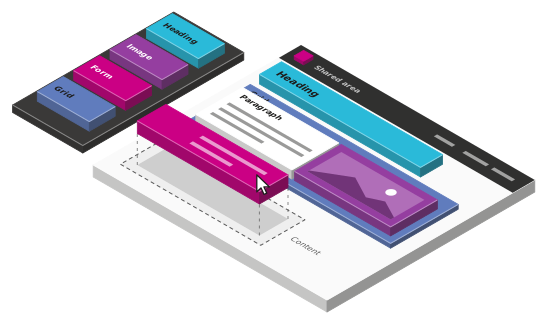
Pick components in the Add Content dialog, place them in a page's areas and drag them to move them.
Every edit is a draft. Preview it, see what changed in the version panel, then publish or revert.
A template sets the layout and holds the Page Area. A Shared Area keeps one header or footer for every template.
Render hooks add padding, CSS classes, date and time windows or audience rules to any component.
A Conditional Panel shows one area or the other: for signed-in visitors, on a given page, or by a value.
Export a page, a template or the shared areas as one JSON file, keep it in your repository, import it elsewhere.
How it works
01
Add it to the page tree. It starts as a draft.
02
The template's Page Area decides where the page's own content shows.
Page Area03
Place them in areas, set their properties and attach render hooks.
IContentRenderHook04
Open the draft with ?preview=Latest and fix what the Issues panel lists.
05
Publish the page. Templates and shared areas publish on their own.
publish_pageFor developers
A Razor component marked VevaComponent shows up in the component picker, and its EditorBrowsable properties become its settings. Register it in your module and restart.
Hook into rendering, conditions and new content.
@using System.ComponentModel
@using Veva.Core.Domain.Attributes
@using Veva.Core.Domain.Components

@attribute [VevaComponent("6b1f0c52-3f0e-4f5e-9a7d-2f8c1e4b9d10")]
@attribute [DisplayName("Notice")]
@attribute [Category("Content")]
@attribute [Icon("fas fa-bullhorn")]
@attribute [AgentHint("A short notice. Set Title.")]

<p class="notice">@RenderContext.DataBindingContext.FormatString(Title)</p>

@code {
    [CascadingParameter(Name = "RenderContext")]
    public RenderContext RenderContext { get; set; }

    [EditorBrowsable, Parameter, DisplayName("Title")]
    [EditorArgument("databinding", true)]
    public string Title { get; set; }
}
Keep reading
Write a component and register it in a module.
Read the guideRender hooks that change how any component renders.
Read the guideGive a component areas that editors fill.
Read the guideModules
The ones marked Built in come with Veva.Web.Essentials. Add the others as packages, restart, and set them up in the site's settings.
Veva.Modules.Pages Renders the pages: finds the website, page, template and theme, serves the 404 page and security headers, and holds the page settings.
dotnet add package Veva.Modules.PagesVeva.Modules.Pages.Design The Pages section of the admin, and the designer's tools in the page: select components, drag them and set their properties.
dotnet add package Veva.Modules.Pages.DesignVeva.Modules.StandardViewComponents 48 components, from Heading, Paragraph and Link to Tabs, Data Table, Navigation menu and Bread crumbs, and styling options such as margin and padding.
dotnet add package Veva.Modules.StandardViewComponentsVeva.Modules.Navigation Hand-built menus in the Navigation section, which the Navigation menu component shows.
dotnet add package Veva.Modules.NavigationVeva.Modules.AnimateCSS A component modifier that puts an Animate.css animation on any component.
dotnet add package Veva.Modules.AnimateCSSVeva.Modules.ContentImport Imports Word, PDF and image files as page content: upload, review the proposed components, then insert them.
dotnet add package Veva.Modules.ContentImportMore of Veva
Each one is made of modules. Reference a package, restart, and its components are in the editor.
Components that show, components that fetch, and the binding between them
OpenStructured content you list, filter and serve anywhere
OpenDocument forms that save, generic forms that filter or post
OpenForm answers made into a PDF, downloaded or sent to be signed
OpenOne media library, with images sized on request
OpenCrawl, index and search the whole site
OpenThe admin's AI assistant, and the MCP server coding agents connect to
OpenBuildVeva(), modules, components, themes and hooks
OpenPlain .NET Blazor: three render modes, standard components
OpenData sources, sign-in, mail, analytics and media
OpenEvery module: what comes with Essentials, and the add-ons
Open